OpenRefine in 2025: A Year in Review
As 2025 comes to a close, we want to take a moment to reflect on the year behind us. It has been a year defined less by headline moments than by steady, deliberate progress. Across the project, we focused on consolidation, care, and continuity, strengthening the foundations that keep OpenRefine useful, resilient, and rooted in its community.
This review offers a look back at some of the work that shaped the year, and at the people and practices that continue to sustain the project.
Strengthening how we work together
In May 2025, we completed a revision of OpenRefine’s governance documentation, concluding a process that began in July 2024. This work was not about introducing radical change, but about clarifying the project's structures and dynamics and making them clearer and more transparent. The updated documentation provides better visibility into roles, responsibilities, and decision-making processes, and reflects the diversity of stakeholders who contribute to and depend on OpenRefine.
Alongside this, we continued to improve how we operate day to day through our participation in the Birdardo training programme. This ongoing work supports greater transparency and shared understanding in how the project functions, helping us align our internal practices with the values we promote externally.
During the year, we also published a new Goalposts page to better articulate our development roadmap. This has helped contributors understand where their efforts fit, while offering users a clearer sense of direction and priorities.
Community in practice: the 2025 Online BarCamp
One of the most tangible expressions of OpenRefine’s community this year was the 2025 Online BarCamp. Held fully remotely over four days, the BarCamp brought together community members for around 20 hours of shared discussion and learning.
The event convened 36 participants from across Europe, North America, and South Asia, who spent an average of 6 hours engaged in sessions. Participants came from GLAM institutions, Wikimedia projects, academic research, and professional data work, with strong overlap between these communities. Many attendees identified with multiple roles, as users, trainers, community organisers, and developers, reflecting the hands-on, practitioner-led nature of the OpenRefine ecosystem.
Sessions focused on real-world data cleaning and reconciliation workflows, OpenRefine extensions and development, integrations with Wikidata and GLAM infrastructures, community practices, and emerging questions around scalability and AI-assisted data work. More than anything, the BarCamp was a space for exchange and shared ownership, where experience and curiosity flowed in both directions.
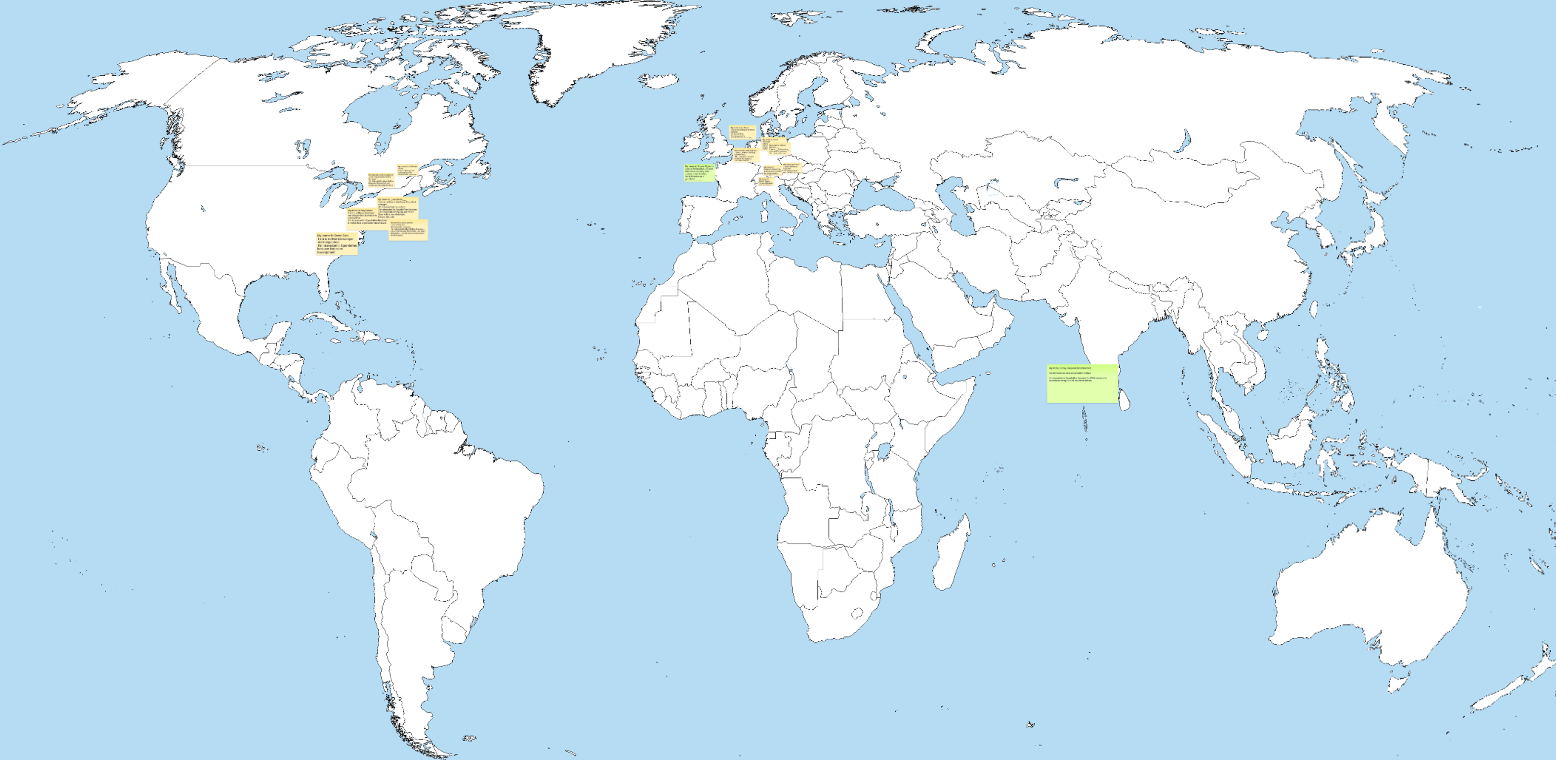
The map below was created during the BarCamp as part of a shared exercise and reflects where participants were joining from.
People and transitions
Projects endure because people do, and 2025 brought both continuity and change to the OpenRefine team. We welcomed new elected committers Benjamin and Sandra, and were glad to see Rory join in the Developer and Contributor Engagement role. We also welcomed Albin to the Core Development Group, strengthening our capacity for long-term maintenance and evolution.
At the same time, we said goodbye to Antonin, whose departure marked a healthy and well-managed transition. Change is a natural part of sustaining an open source project, and we continue to focus on renewal and resilience rather than replacement alone.
During the year, we also issued a call for new members to join the Advisory Committee, as part of our ongoing effort to keep governance representative and responsive.
Shipping software
Software maintenance and reliability remained central to our work in 2025. The year began with the release of the OpenRefine 3.9 series, followed by regular updates through version 3.9.5, and preparations for the upcoming 3.10 release.
Usage of the 3.9 series remained strong throughout the year. Version 3.9.5, released in September, has already seen over 70,000 downloads, averaging close to 20,000 downloads per month. Earlier releases in the series also saw strong uptake, reflecting the continued trust users place in OpenRefine for their data work.
Rather than focusing on sweeping changes, this series prioritised maintenance, reliability, and incremental improvement. Alongside this, the extension ecosystem continued to grow, with three new extensions released during the year, further expanding how OpenRefine can be adapted to different contexts and workflows.
Sustainability and funding
2025 also marked the closing of an important chapter in OpenRefine’s sustainability. In December, we reached the end of the EOSS 5 grant, concluding five years of support from the Chan Zuckerberg Initiative through the EOSS programme, beginning with EOSS 1. We are deeply grateful for this long-term support.
Through the EOSS programme, we developed, tested, and institutionalised durable community practices that balance the needs of users and contributors. These practices have strengthened OpenRefine’s responsiveness, increased its capacity for innovation, and improved contributor retention, leaving the project in a healthier position than when the programme began.
As we move forward, we are actively engaging with institutional and philanthropic partners, with the support of the FLOSS/fund and several funding applications currently in progress. This year also saw the launch of our first dedicated fundraising campaign, and the opening of the OpenRefine store as a modest additional way to support the project. We will share more about these efforts in the new year.

None of this work would be possible without the generosity of our donors, contributors, and partners. We are grateful for the time, expertise, trust, and resources that so many people continue to invest in OpenRefine.
Thank you
OpenRefine remains a collective effort. Whether you contribute code, documentation, training, financial support, or simply use the tool in your daily work, you are part of what sustains the project.
As we close the year, we want to thank everyone who has helped carry OpenRefine through 2025. We invite you to stay involved, to contribute where you can, and, if you are able, to support the project so it can continue to serve its community in the years ahead.
Thank you for being part of OpenRefine.
2025 Donor Shoutouts:
If you would like to support OpenRefine, please consider making a donation at https://openrefine.org/donate.
We would like to thank our 2025 individual and institutional funders, including FLOSS/Fund and The Antoine Bello Philanthropic Fund, as well as individual supporters Joel Gardner, Jasmine Saffold, and Nicolas Semrau, along with two anonymous donors.
We also gratefully acknowledge GitHub users who supported OpenRefine through individual contributions: RefinePro, ostephens, DaxServer, alanorth, timtomch, trantor, wetneb, EstebanMH-SiB, btseee, and Balise42.
2025 GitHub Contributor Shoutouts:
Our contributors play a critical role in our success. If you're looking for opportunities to get involved, you can start here: https://openrefine.org/community.
In alphabetical order, the 51 contributors to OpenRefine repositories during 2025 included the following accounts: Abbe98, Abhinav Pandey, Adem Özcan, Alan Orth, Albin Larsson, alex, Aman Kumar, amansingh-swe, Andi Chandler, Antoine Beaubien, Antonin Delpeuch, Arianne Pady, Benjamin Rosemann, DaxServer, DevangJagdale, Dhyan Patel, Esther Jackson, Ettore Atalan, Isao Matsunami, Jiří Podhorecký, Johann150, Jyothi Swaroop Reddy, kalinda, Keith Cirkel, Luca Martinelli [Sannita], Martin Magdinier, Nicolas @belett VIGNERON, Pierre-Yves Beaudouin, Rafael A Encinae Rodriguez, Ritoban Dutta, Rory Sawyer, Sandra Mierz, Sashank, Savvas Chrysostomidis, sunilnatraj, Thad Guidry, Tom Morris, XiaohanMu, Yaron Shahrabani, Yunus Emre BAYRAKTAR, Zarif León, ود علم الهدي, தமிழ்நேரம்